


Blog
The Foundation of Scalable AI Infrastructure

Building the Network Fabric for Next-Generation AI
Executive Summary
Artificial intelligence workloads are rapidly transforming the architecture of modern data centers. While GPUs and AI accelerators often receive the most attention, the networking fabric connecting these systems is equally critical. Training large language models, running distributed AI inference, and processing massive datasets require ultra-high bandwidth, extremely low latency, and lossless communication between compute nodes.
Traditional enterprise networks designed for general IT workloads struggle to meet these demands. AI infrastructure instead relies on specialized networking fabrics capable of supporting thousands of GPU nodes working together as a single distributed computing system.
In this article, we explore what AI networking fabrics are, how they differ from traditional data center networks, and why they are becoming the backbone of modern AI infrastructure.
The Rise of Distributed AI Workloads
Modern AI models have grown dramatically in size and complexity. Training large models such as transformer-based architectures requires massively parallel computing across hundreds or thousands of GPUs.
Instead of running on a single server, AI training is distributed across a cluster of GPU systems. Each node processes a portion of the dataset while continuously exchanging gradients, parameters, and intermediate results with other nodes.
This process creates enormous east-west traffic inside the data center.
In a typical AI training environment:
• GPUs must synchronize model parameters every few milliseconds
• Terabytes of data move between nodes during training
• Communication latency directly impacts model training speed
If the network becomes a bottleneck, expensive GPU clusters cannot operate at full efficiency.
As a result, the network fabric has become one of the most important components of AI infrastructure.
What Is an AI Networking Fabric?
An AI networking fabric is a high-performance interconnect architecture designed to support distributed AI and high-performance computing workloads.
Unlike traditional enterprise networks optimized for north-south traffic (client to server), AI fabrics are optimized for east-west communication between compute nodes.
A typical AI networking fabric connects:
• GPU servers
• high-performance storage systems
• distributed AI clusters
• orchestration and management platforms
The goal is to ensure that thousands of compute nodes can communicate as if they were part of a single large system.
Key characteristics of AI networking fabrics include:
• ultra-low latency communication
• extremely high bandwidth
• lossless packet delivery
• scalable architecture supporting thousands of nodes
These capabilities enable efficient distributed training and inference across large AI clusters.
Why Traditional Data Center Networks Are Not Enough
Most enterprise data centers are built using network architectures designed for business applications such as databases, virtualization platforms, and web services.
While these workloads require reliable connectivity, they do not generate the same communication patterns as distributed AI systems.
Traditional networks often experience challenges when used for AI workloads:
Latency Sensitivity
AI training frameworks rely on frequent synchronization between nodes. Even small network delays can significantly increase total training time.
Bandwidth Requirements
Large AI models exchange massive amounts of data between GPUs. Standard 10Gb or 25Gb networking quickly becomes insufficient.
Packet Loss Impact
In distributed training environments, packet loss can disrupt collective communication operations and reduce overall cluster performance.
Network Congestion
Without specialized congestion control mechanisms, traffic bursts from multiple GPU nodes can overwhelm network buffers.
Because of these factors, AI infrastructure requires networking fabrics designed specifically for high-performance distributed computing.
Key Technologies Behind AI Networking Fabrics
Modern AI networking fabrics rely on several advanced networking technologies to achieve the required performance and scalability.
High-Speed Ethernet
One of the most common technologies used in AI infrastructure today is high-speed Ethernet.
Modern AI clusters frequently use:
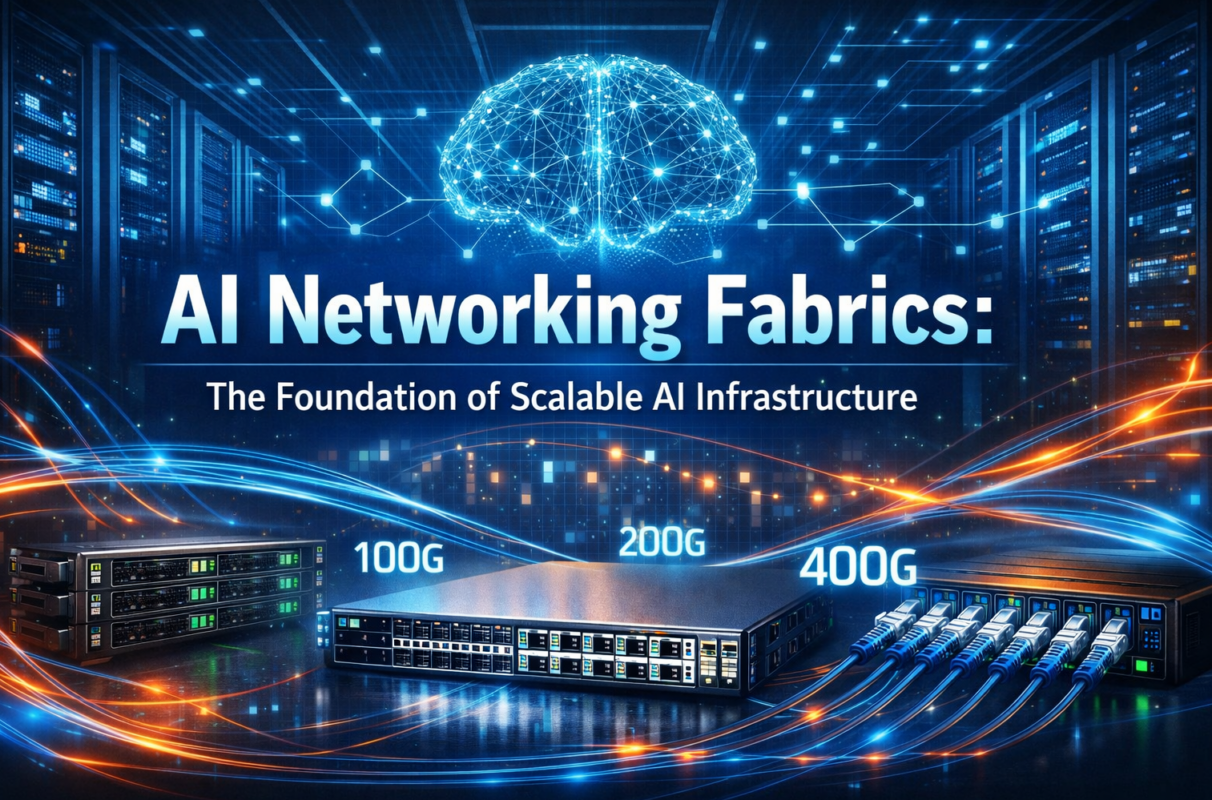
• 100Gb Ethernet
• 200Gb Ethernet
• 400Gb Ethernet
These high-bandwidth links enable GPU clusters to exchange large datasets rapidly and maintain synchronization across nodes.
High-speed Ethernet has become increasingly attractive due to its broad ecosystem and compatibility with existing data center infrastructure.
RDMA (Remote Direct Memory Access)
RDMA is a key technology that significantly improves network efficiency in distributed computing environments.
RDMA allows one system to access the memory of another system directly across the network without involving the CPU.
This approach provides several advantages:
• extremely low latency communication
• reduced CPU overhead
• higher throughput for distributed workloads
RDMA is commonly implemented through technologies such as RoCE (RDMA over Converged Ethernet).
GPU-Optimized Networking
AI infrastructure often requires networking systems specifically optimized for GPU communication.
Technologies such as GPU-direct communication allow GPUs to exchange data across the network with minimal overhead.
This capability reduces latency and improves the efficiency of distributed training frameworks.
These optimizations are especially important in environments where hundreds of GPUs operate as part of a single training cluster.
Lossless Ethernet
AI communication patterns often rely on collective operations such as all-reduce, where many nodes exchange data simultaneously.
Packet loss during these operations can significantly degrade performance.
To address this challenge, AI networking fabrics often implement lossless Ethernet mechanisms, including:
• Priority Flow Control (PFC)
• Explicit Congestion Notification (ECN)
• Data Center Bridging (DCB)
These technologies help maintain stable and predictable network behavior under heavy traffic conditions.
AI Network Topologies
In addition to networking technologies, the topology of the network fabric plays a critical role in performance and scalability.
Most large AI clusters use spine-leaf architectures, which provide predictable latency and high bandwidth between nodes.
Leaf Layer
Leaf switches connect directly to GPU servers and storage systems.
Each server typically has multiple high-speed network interfaces to support parallel communication paths.
Spine Layer
Spine switches provide high-capacity interconnects between leaf switches.
Every leaf switch connects to every spine switch, ensuring consistent latency across the cluster.
This architecture enables non-blocking communication between thousands of compute nodes.
The Role of AI Networking in Training Performance
The performance of distributed AI training environments is heavily influenced by the efficiency of the networking fabric.
In large clusters, GPUs frequently exchange gradient updates and model parameters.
If network bandwidth or latency becomes insufficient, GPUs may remain idle while waiting for synchronization operations to complete.
This leads to lower hardware utilization and longer training cycles.
Optimized AI networking fabrics help ensure that:
• GPU resources remain fully utilized
• training iterations complete quickly
• cluster scalability remains predictable
In large AI environments, improving network performance can significantly reduce the total cost of training large models.
AI Infrastructure as an Integrated System
Modern AI infrastructure must be designed as an integrated system combining compute, storage, and networking components.
Successful deployments require careful coordination between:
• GPU servers
• high-performance storage platforms
• networking fabrics
• AI software frameworks
The networking fabric serves as the central nervous system of the AI cluster, enabling communication between all other components.
Organizations building AI infrastructure must therefore consider networking architecture early in the design process.
Enterprise Adoption of AI Networking Fabrics
As AI adoption expands across industries, organizations are increasingly investing in dedicated AI infrastructure.
Enterprises building AI platforms for data analytics, machine learning, and generative AI applications must ensure their infrastructure can support distributed workloads efficiently.
This shift is driving demand for:
• GPU-optimized networking solutions
• high-bandwidth Ethernet fabrics
• scalable AI cluster architectures
Many organizations are moving toward AI-ready data centers, where networking infrastructure is designed specifically to support accelerated computing environments.
Key Takeaways
AI networking fabrics have become a critical component of modern data center architecture.
As AI workloads continue to scale, traditional networking approaches are no longer sufficient to support distributed GPU computing.
Key considerations for AI networking include:
• ultra-high bandwidth interconnects
• low-latency communication between nodes
• lossless networking for distributed training
• scalable spine-leaf architectures
Organizations investing in AI infrastructure must carefully design their networking fabrics to ensure that compute resources operate efficiently and that AI workloads can scale reliably.






Recent Comments